

B2C went digital fifteen years ago. B2B… didn’t.
While Amazon perfected one-click checkout, distributors still juggle PDFs, Excel sheets, calls, and unending email threads.
French-Italian startup Volta, created in 2024, believes the gap is now too wide to ignore and too strategically important to leave unsolved.
Less than a year after raising €6 million, the company has secured another €5 million, this time led by global early-stage venture firm RTP Global, bringing total funding to €11 million. With over €1 million in new revenue in the past six months and a team that has grown from 5 to 30 in under a year, Volta is moving fast.
CEO Paul Guillemin is on a mission: build the AI-powered operating system that will finally drag B2B commerce into the 21st century.
“B2B is a major digitalization challenge,” Guillemin said.
The Last Undigitized Frontier
The problem is glaring: although B2C embraced digital tools over a decade ago, B2B workflows remain painfully manual. Orders arrive as PDFs, Excel sheets, emails, WhatsApps, and yes, even fax. Prices are updated by hand. Catalogs are scattered. Sales reps spend 70% of their time doing admin instead of selling.
And yet, the French B2B e-commerce market alone is worth nearly €360 billion.
“The new generation of distributors knows this is no longer sustainable,” Guillemin said. “Ignoring digitalization means losing a competitive advantage.”
Throw in the recent explosion of generative AI, and the mismatch between B2B workflows and modern tech is startling.
According to Volta, it’s time to unify
An AI Back Office
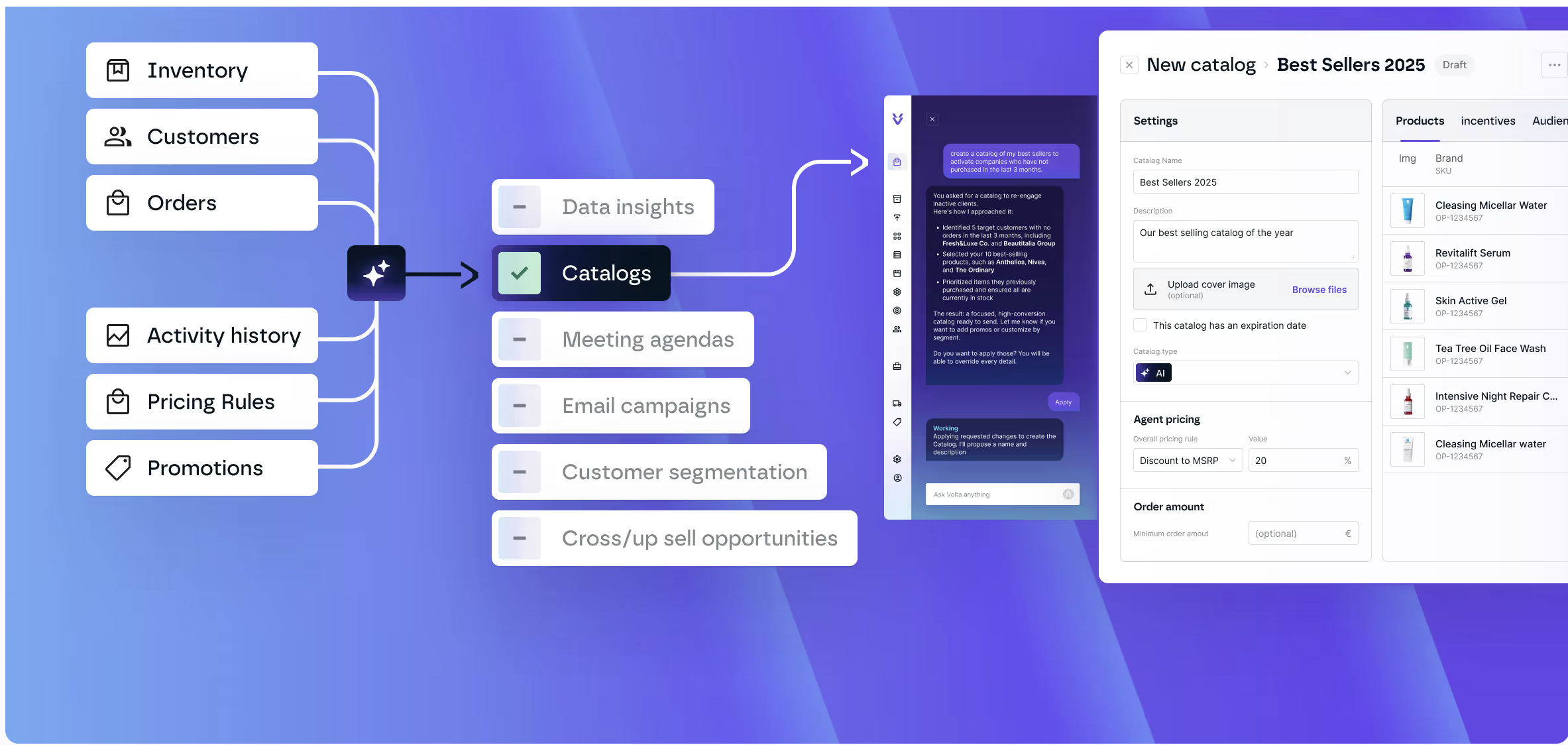
Volta positions itself as a collaborative SaaS back office designed to centralize and automate the entire B2B sales process. Look at it like an over-the-top operational brain that brings together ERPs, CRMs, PIMs, and warehouse systems, the connective tissue that distributors were missing.
The Volta platform rests on three pillars:
- Amplify: Once the data is centralized, the platform proposes personalized product recommendations, price suggestions, opportunity detection, and AI-guided decisions on who should buy what, when, and at what price.
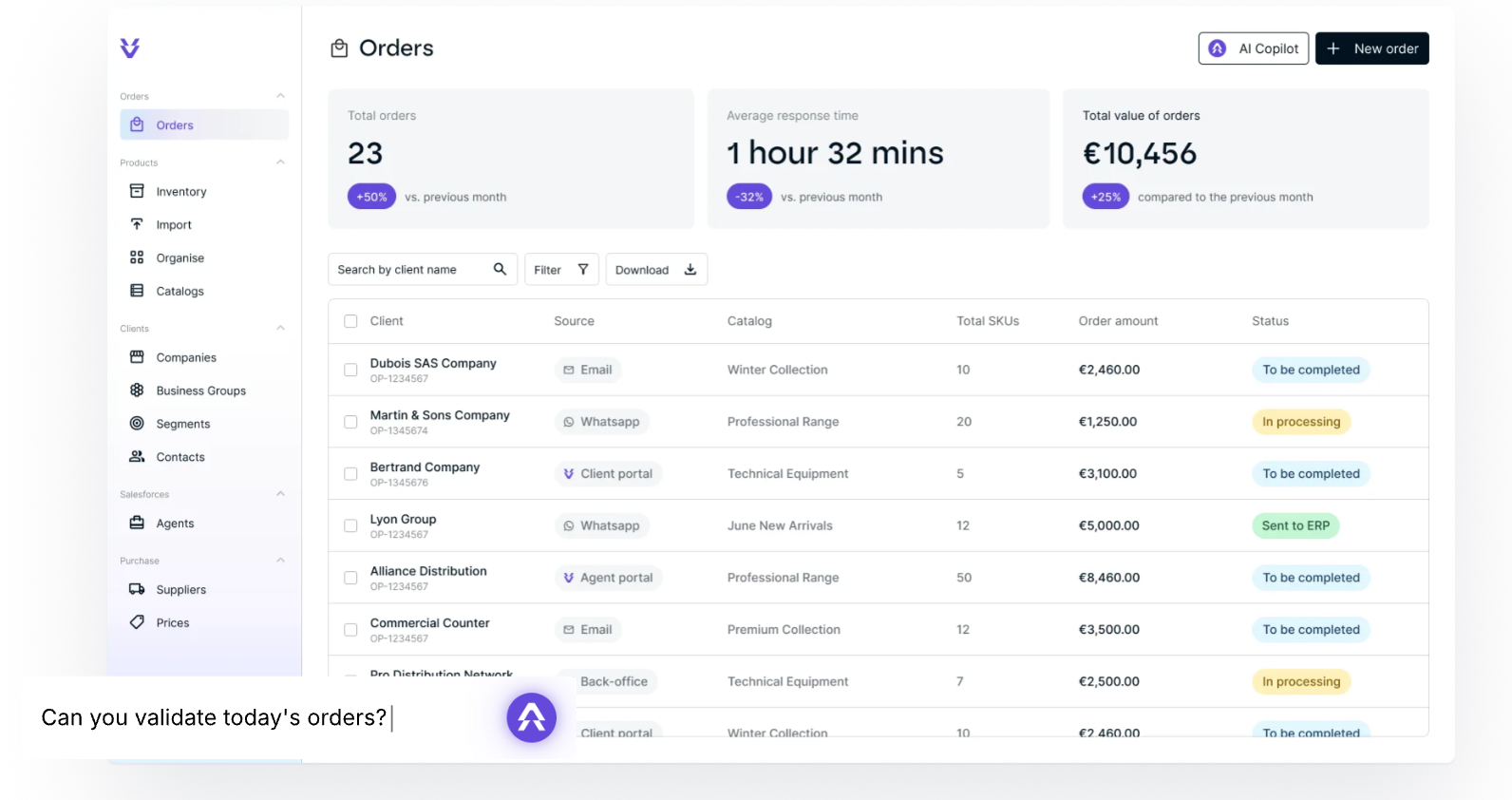
- Automate: Volta’s AI parses emails, extracts product lists from attachments, checks stock availability, assigns the right prices, and drafts the purchase order automatically. “It’s a massive time saver,” said Guillemin. “The sales rep just validates the draft. The AI does the footwork.”
- Unify: All channels flow into one place with the platform acting as the real-time cockpit of the business. That includes emails, PDFs, field sales reps, online portals, WhatsApp orders, etc.
“If you sold Advent calendars last year, Volta will politely and accurately nudge you ahead of time,” Guillemin joked.
A Tale of Two Founders, Two Countries, and One Big Market Gap
Volta is the child of a French founder living in Milan, Guilleman, and an Italian founder married to a Frenchwoman, a sort of cross-border entrepreneurial rom-com.
Guillemin met Mario Parteli (ex-Rocket Internet and founder of two startups including, beauty box distributor Abiby) through mutual friends. Parteli had been experimenting with selling inventory to distributors and was shocked by how archaic their processes were.
“He was experiencing firsthand the problems we solve today: endless copy-pasting, manual updates, broken catalog data,” Guillemin recalled. “I asked him whether a system existed to automate all this. It didn’t. So we built it.”
Both had deep operational scars from working with wholesalers, logistics, and back-office operations. Guillemin had previously founded Fretlink, a transportation operating system that connects shippers (SMEs & large corporations) with supply chain organizations looking to transport goods across Europe. For Guillemin, Volta is the natural next step, moving upstream into B2B sales processes.
The connection clicked immediately. So did the market opportunity.

Seed to Speed
Volta raised a €6 million seed round a year ago in November 2024, with European pre-seed VC, EMBLEM, alongside 40 global investors.
“We carried out a first funding round and then realized we needed more firepower to go faster,” Guillemin stated.
This latest €5 million round is led by RTP Global, an international heavyweight with stakes in Qonto, SumUp, and Datadog. Also joining: Pascal Houillon, former CEO of Sage and Cegid, a strong signal given Volta’s ambition to become the standard B2B operating system.

The Market
Volta is attacking two markets simultaneously: Italy and France, Europe’s largest distribution hubs.
Volta is a SaaS subscription, priced according to order volume, catalog size, and business complexity. Its customers are a mixture of distributors, wholesalers, and manufacturing groups that also distribute their inventory. Key sectors include cosmetics, footwear, DIY, building materials, and food distribution. In other words: horizontal by design, vertical in execution.
Italy provided initial customer traction; France required acceleration. Both markets are now 50/50 in Volta’s customer base.
Being a Repeat Founder Helps
Volta may be new, but Guillemin isn’t. Volta is his fourth startup.
“With each company, you learn,” he said. “This time, I already had a strong tech team, product team, and the network. Things that took me five years before, this time we were able to do in one.”
Many early employees came from his previous venture. The speed shows: from 5 to 30 employees in under a year, and over €1M in new revenue in six months.
“We had the right team, the right timing, and the right product,” he said. “A rare alignment of planets.”

Race to Build Europe’s AI OS for B2B
With €11 million raised, Volta is looking to scale its go-to-market in France and Italy and keep developing the platform:
“We’re constantly getting feedback from customers asking us to develop more product modules for their particular use cases,” Guillemin said.
Volta has no direct European competitors today. Most competing companies focus on a single functionality, such as email or order automation. But the AI explosion will undoubtedly attract a whole new array of upcoming competitors to the B2B commerce sector. Volta’s objective is to claim the territory before new entrants solidify their position and become the European category leader.
In the coming months, the startup plans to accelerate hiring, deepen its AI capabilities, and pursue broader European expansion.
“In five years, I’d like to see tens of thousands of businesses using Volta, saving themselves huge amounts of time and focusing on sales rather than admin,” said Guillemin. “If we can move this massive industry from Post-its and Excel to AI-driven operations, we’ll have succeeded and our customers will have succeeded with us."